

Babbo is Back
In a very different Italian New York

Restaurant comebacks are rarely just about the food; they’re about timing, context, and how much the city has changed in the meantime.
I’m sadly too young to have really known what the early / mid-2000s original Babbo was like but Matt Rodbard, Robert Sietsema and many many former-Batali waiters have painted a very clear picture of the experience over the years:
“the Heat era of 2006. Batali was at the height of his powers… I tried fried veal sweetbreads for the first time. Thrilling, it was, to dine upstairs and eat rich, hand-stuffed pastas and drink too much wine like our hero suggested we do in the book while all that dusty dad rock played….
This was an era before Rezdôra, before Missy Robbins’s triumphs, and before Evan Funke doing amazing things out west—interesting cooking made with a real chef’s point of view, either mining traditions or employing a creative spark. Batali was just playing the nonna hits, and he was leaning into cream and butter and fatty meats in a pretty disgusting way.”
In the last decade, the Italian and Italian-American scene in New York has splintered and multiplied in ways that would have felt unrecognizable during Babbo’s original reign, moving away from heavy, indulgent nonna hits toward a far more diverse and compelling spectrum.
Today, rustic Brooklyn-leaning interpretations like Borgo and Lilia (and the broader Missy Robbins empire that followed since Lilia’s original opening in 2016) sit alongside highly regional concepts like Rezdôra - with its focus on the Emilia-Romagna region of Italy, whose success has led to a sister expansion in Massara. Star-studded restaurant groups like Major Food Group have revived and recontextualized their own Italian history, taking Torrisi, once a counter-service institution known as Torrisi Italian Specialties, and rebirthing it as something far grander and glitzier.
True Italian imports have also arrived, like Roscioli and Una Pizza Napoletana, signaling a growing appetite for Italian cooking that doesn’t bend itself toward American nostalgia but instead insists on regional precision and restraint. At the same time, more fluid, wine-driven restaurants like I Cavallini — the newest of the restaurants on the Italian/Italian American scene, with an ever-evolving menu and continued emphasis on natural wine — reflect a looser, more contemporary approach to Italian dining altogether. Meanwhile, the city’s most traditional red-sauce institutions, Emilio’s Ballato, Rao’s, Bamonte’s, now feel as celebrated for their atmosphere, people-watching, and cultural mythology as for the food itself.
Which brings us to Babbo’s reopening, and, more specifically, to who is now behind it.
Babbo’s return has now overseen by Stephen Starr of Starr Group, whose approach to restaurants has long favored clarity, consistency, and cultural relevance. Known for building and maintaining large-scale dining institutions, Starr brings a distinctly different kind of authorship to Babbo, one rooted less in chef-driven expression and more in longevity, stewardship, and control; and, you feel that the second you walk into the newly opened Babbo dining room.
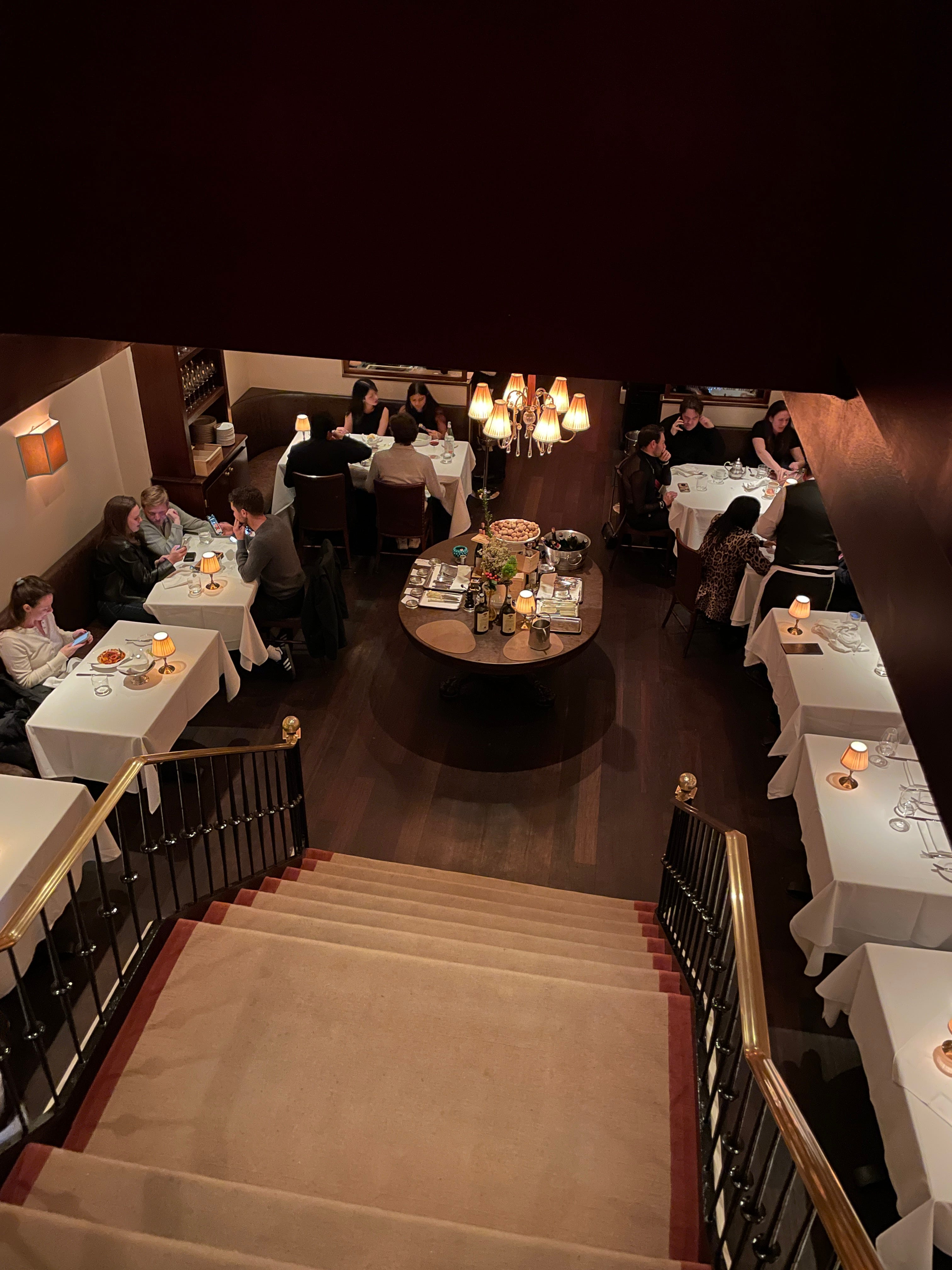
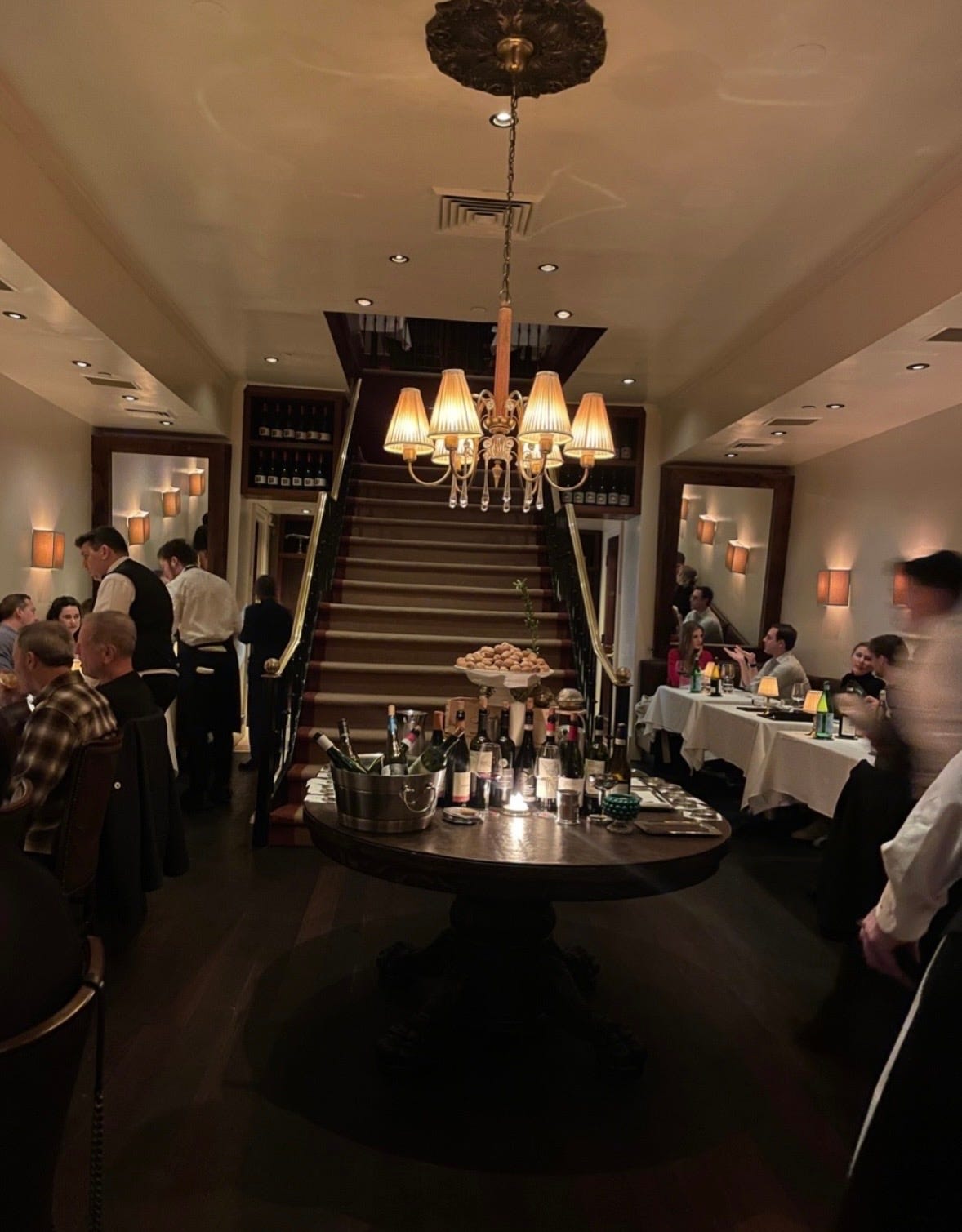
The restaurant, divided across two levels, opens onto a wide, dramatic staircase, with the ground floor wrapped in booth-lined seating that feels both grand and intimate. Each table is lit by ornate miniature lamps, casting a warm, flattering glow. In the center of the room stands a central hosting table centered below a similarly delicate chandelier.
Upstairs, the room turns seductively red, a younger, more confident sibling to the space below. Red-lined walls are punctuated by the same ornate lamps, wine-bottle bookshelves, and a dramatic central island around which the tables orbit, stocked with extra silverware, sculptural florals, gilded-like silver water pitchers, and beautiful bottles of olive oil and balsamic vinegar imported from Italy.


The energy was buzzy yet relaxed—loud and lively, but never chaotic—service prompt and nearly invisible. Our server was charming, stopped by at just the right cadence to guide us confidently through the sizable menu which is organized into five distinct sections. The first, Babbo crudi trios, which for $39 offered a raw sampler of fluke, trout and tuna with delicate accoutrements like capers and garlic breadcrumbs. From there, the menu moves into antipasti, a mix of salads and warm starters, including the highly recommended warm lamb’s tongue with truffled mushrooms, which we skipped. Primi, the pasta section, anchors the menu, followed by secondi, a robust lineup of mains ranging from marsala preparations to rabbit cacciatore to barbecued squab for $69. The final section, contorni, is the briefest and most straightforward; it was neither emphasized nor particularly guided, and we paid it little attention.
We put our trust in the wine entirely in Sofia—my coworker, whose family lives full-time in Italy—who ordered a perfectly balanced red while the rest of us debated the menu. Zeroing in on the pastas, we landed on four, though not without having to navigate Mel’s strong aversion to cheese, which ultimately got the goat cheese tortellini with fennel pollen vetoed off the list. We learned early on that the internet-hyped 100-layer lasagna had been taken off the menu, a quiet disappointment that lingered at the table. To round out the carbs, we added a green to start, narrowed everything down in the Notes app, and then, feeling surprisingly decisive, placed our order.


Feeling originally indifferent to much of the antipasti section, I was pleasantly surprised by the escarole salad, lightly dressed and thoughtfully composed so that each bite of bitter lettuce carried a walnut crunch and a subtle onion tang. The bread arrived warm, served alongside a creamy, airy ricotta (or something close to it), topped with black salt and finished with a generous drizzle of olive oil poured tableside.


In near-perfect coordination, all four pastas landed on the table at once.
The linguine vongole arrived with the clams already removed from their shells, the noodles cooked al dente, while the sauce leaned creamier than the classic preparation, coating the pasta generously and finished with a scattering of garlic breadcrumbs that added texture more than bite.
The black spaghetti arrived, tangled with rock shrimp, Calabrian chiles, and green chiles, its inky strands glossy and assertively seasoned. Despite the menu listing Calabrian sausage, its presence was difficult to detect, leaving the heat and brine of the shrimp to do most of the work. Of the four pastas, this was the one I found myself reaching for the least.
The pappardelle bolognese was built on wide, thick sheets of egg pasta with softly ribboned edges, clearly handmade and sturdy enough to carry the weight of the sauce. Rich and satisfying, it ate comfortably and confidently, although not totally memorably. The pasta itself the standout rather than the ragù.
The beef cheek ravioli stood apart. Thick, carefully folded pockets of pasta gave way to a deeply savory filling, surrounded by a rich, creamy sauce layered with liver and truffle notes. It was the most distinctive dish on the table even though it only bare two or three bites per person.


Dessert arrived in the form of two very different conclusions. The chocolate olive oil cake felt like the obvious choice, but it ultimately leaned far more chocolate-forward than expected—dense and rich, topped with a thick layer of chocolate frosting that pushed it closer to a traditional chocolate cake than the lighter, olive-oil–driven dessert I had anticipated. The prune crostata, on the other hand, was a wildcard order that quietly stole the show. Rustic and restrained, the fruit soft and deeply concentrated, it struck a rare balance between sweetness and depth, each bite feeling thoughtful rather than indulgent. It ended up being one of my favorite moments of the meal.


Taken together, Babbo’s return most closely resembles the recent wave of Italian restaurant revivals led by large hospitality groups—restaurants that take over household names and reintroduce them as buzzy, high-gloss destinations. In that sense, Babbo feels spiritually aligned with Torrisi: loud, late, expensive, and engineered for a good time. The difference is that Torrisi delivers a level of precision and polish that Babbo doesn’t quite reach. If what you’re after is that caliber of craft and detail, Torrisi remains the clearer choice—even if it means eating at an ungodly hour.
That contrast was especially apparent dining at Rezdôra the night after, where hospitality feels almost ceremonial: every arrival anticipated, every detail noticed, every moment calibrated from the warm mulled wine handed to you upon arrival to the decorative birthday card signed by each staff member when departing. Babbo doesn’t operate at that level, nor does it seem to be trying to. The service is capable and fluid, the room energetic, the experience designed more for momentum than intimacy.
Babbo isn’t a 10-out-of-10 meal, but it’s a solid, and fun, eight. It’s loud, lively, and built for groups, with a bill that landed around $78 per person pre-tip, including two desserts and a bottle of wine, meaningfully less than a night at Rezdôra. That difference doesn’t feel like paying for lower quality so much as paying for a different kind of night altogether.
Babbo today isn’t the place I’d choose for a quiet, intimate birthday dinner or a date night meant to linger. But for a big table, a late reservation, and a room that carries history while embracing spectacle, it largely succeeds. The comeback may not rewrite the Italian playbook in New York, but it doesn’t need to. It just needs to know exactly what kind of experience it’s offering, and for the most part, it does.
I used to watch Mario Batali on The Chew - still fame for his linguini w/clams.
Your review is so authentic and refreshing of dishes you describe while dining at Babbo. Thank you
Thoughtful take on the comeback. The comparison to Torrisi is spot-on, both are doing the big-group-energy thing but Torrisi def has more polish. What struck me was that observation about Starr bringing stewardship over authorship, which kinda explains why it feels competent but not particualrly memorable. I had the beef cheek ravioli at the old Babbo years ago and it was one of those dishes that made you rethink what pasta could be, curious if it still has that effect or if its just solid now.